How much of your day is spent on screens versus in the real world.
Visualizing_
slider Screen Time
Screen Time — Position your product or practice directly against the habit it replaces — make the contrast visible so people feel the choice.
Screen Time measures how much of someone's day is spent on screens versus in the real world. The insight that crystallized during Chris McElroy's call was that Knox Provisions isn't just competing with other optics brands — it's sitting at the exact intersection of the screen-time problem. People go to beautiful places and spend the whole time filming instead of seeing. Binoculars offer the opposite: you have to be present to use them. That's the brand story.
Scott Tannen introduces the screen-time reframe to Chris McElroy — proposing that Knox Provisions isn't competing with other gear brands but with the distraction economy itself.
"i actually think your biggest competition is distraction right and and i'm really interested in this whole movement of p..."

 Screen Time
Screen Time — Replace a portion of your daily screen time with something that requires your hands and produces something physical.
Screen Time measures how much of your day runs through a screen versus direct contact with the physical world. Valerie Sizemore made a deliberate choice to reduce screen engagement and shift toward hands-on, material-based activity — calligraphy, wood carving, stone knapping. They describe thinking more intentionally about computer use overall and trying to get more connected to the real world. This wasn't accidental drift; it was a conscious recalibration of how much of their life they wanted mediated by a screen.
Valerie Sizemore describes the personal turn toward physical, hands-on creation as a deliberate response to AI — and how that shift pulled them away from screens and toward direct contact with the material world.
"i have felt a lot more call to make art that's been a bit of my journey over the last six years got really into calligra..."

 Screen Time
Screen Time shifted dramatically when Trang Nguyen moved her entire workday into a sunny laundry room three feet from two bearded dragons. Before the pandemic, her screen time was compartmentalized — work at work, home at home. Once she started spending 8-9 hours daily on Zoom calls while simultaneously googling "why are bearded dragons turning orange" and "do lizards need lotion," her digital and physical worlds completely merged.
Trang explains how her work-from-home setup during the pandemic completely merged her digital and physical worlds as she spent full days on screens while caring for lizards.
"i'm back there eight nine hours a day three feet from a tank of lizards and a laptop i know nothing about reptile health..."

 Screen Time
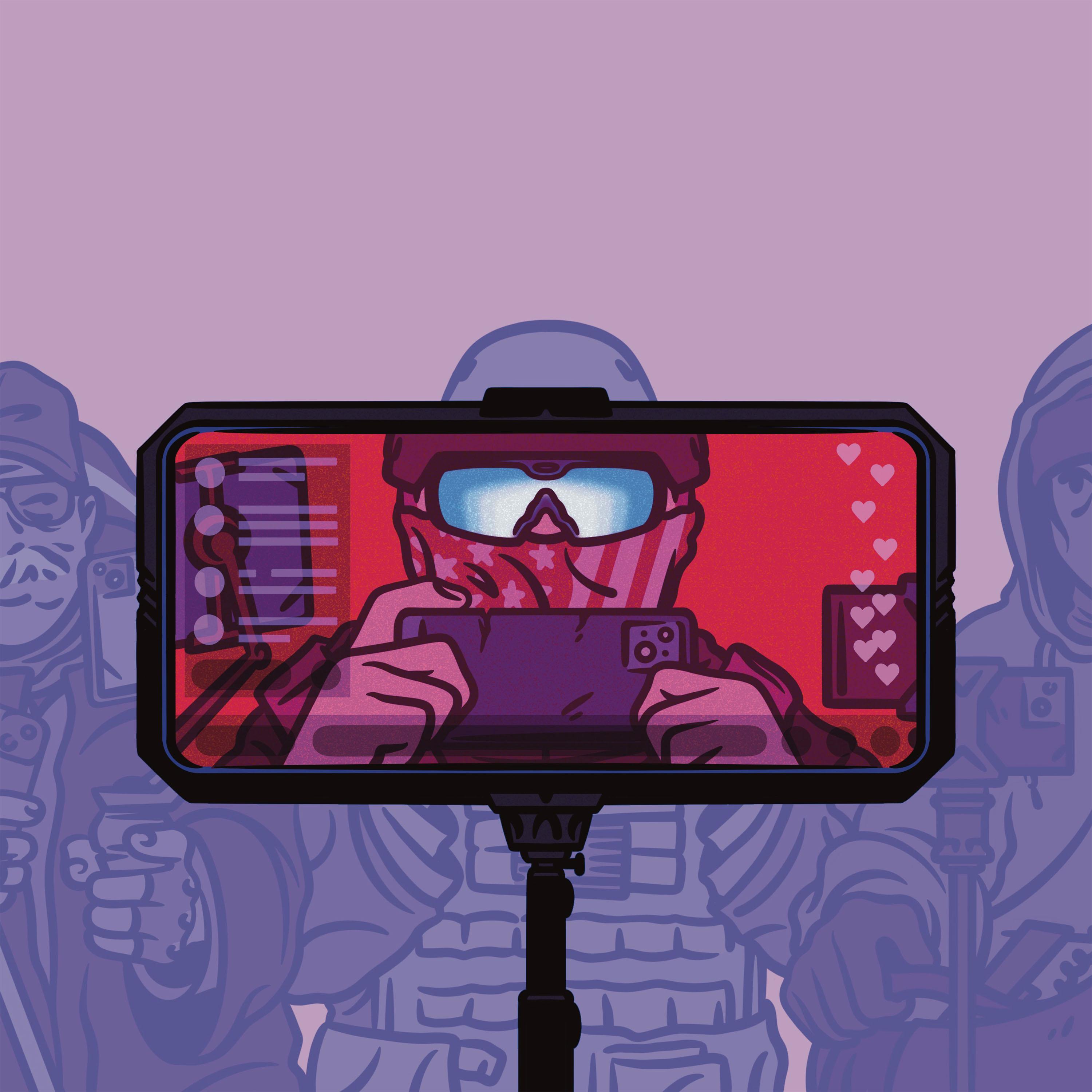
Screen Time shifted dramatically for Mike Ross as he found purpose through streaming. Before, his real world was filled with trauma, a strained marriage, and isolation. He recalibrated from mostly real world (but disconnected) to mostly screens (but connected), discovering that online relationships could be more supportive than his offline ones. His chat became his support system where he could live out his Marine values of standing up for the vulnerable.
Mike Ross is helping a streamer's wife whose husband just got arrested, mobilizing his online chat to raise bail money.
"people wanna know how to how to give money so in a minute we'll walk down to tommy's chat and you can talk to bo chats a..."
 Screen Time
Screen Time became intentional when Fred Rogers recognized that children were already spending hours watching TV. Rather than fighting against screen time itself, he recalibrated to make those screen hours developmentally appropriate. Fred Rogers designed his show to encourage real-world play and connection, using the screen as a bridge to authentic human experience rather than a replacement for it.
 Screen Time
Screen Time relates tangentially to Julian Edelman's shift. His struggle was with the hours of film study - essentially screen time for NFL players. Before coffee, he couldn't handle the mental load of staring at game film for hours. After discovering coffee, he could manage those long sessions better. While the story is more about energy management than screen time itself, there's a connection to how he dealt with the required hours of film study.
 Screen Time
Screen Time shifted after the attack when Mandy Palmucci became obsessed with scrolling articles about the victims. She went from using constant travel to avoid her feelings to using screens to torture herself with survivor's guilt. The real world became too threatening - big windows, dark spaces, public places all triggered her, so screens became both escape and self-punishment.
 Screen Time
Screen Time shifted after the attacks. Mandy Palmucci went from constant travel and activity to obsessive scrolling and reading articles about the Paris attacks. She withdrew from public spaces but dove deep into screens, researching victims, reading every update. The balance between real world and digital changed — screens became both a refuge and a way to torture herself with survivor's guilt, though eventually therapy helped her reconnect with the physical world.
 Screen Time
Screen Time adjusted from passive observer to active participant. While watching post-election violence on TV from home, Adele Onyango felt disconnected and guilty about her safety. When her mother declared she'd join the protest, Adele shifted from screen-based consumption to real-world action. She left the comfort of watching news coverage to run through tear gas, dodge police, and experience the protest firsthand.
 Screen Time
Screen Time controlled how Natalie approached the moon tree story. She started with screens — maps, research, verification — treating it as intellectual work. When she decided to drive to San Luis Obispo and touch the actual tree, she shifted from mostly screens to mostly real world. Natalie Middleton discovered that experiencing the redwood with her hands brought tears that no amount of research could have predicted.
Natalie Middleton describes leaving her research screens behind to physically experience the moon tree she had been documenting.
"and when i saw it it was just it it i actually got kind of emotional like i i went up to its trunk and i like touched it..."

 Screen Time
Screen Time appears subtly in Joe Linsky's story through the viral video of his attack. Joe had to decide how much mental space to give this digital version of his trauma that was spreading across screens worldwide. While he initially threw his phone down after watching it, he eventually found balance — using the video as a reminder of his survival rather than obsessing over it. He also mentioned being on his phone when pushed, showing how a moment of digital distraction intersected with real-world violence. Joe had to recalibrate how much screen exposure he could handle while healing.
Joe Linsky describes finding strength in watching the video of his near-death experience, using it as proof of his survival rather than dwelling on what almost happened.
"and i'm glad i can watch this happen to myself because it gives me the strength to know that i am alive and how much gra..."
 Screen Time
Screen Time played a subtle role in how Maliki Mardanali fought his battle. He used social media campaigns and constant phone calls to pressure government officials, living partly in the digital battlefield. When he shifted to wanting agreement instead of victory, he moved from online pressure tactics to considering face-to-face relationship building. The story touches on this balance between digital campaigns and real-world negotiations.
 Screen Time
Screen Time shifted from mostly screens to balanced when Fred Rogers moved from television work obsession to handwritten letters. He'd been living in the world of production schedules and scripts, disconnected from real human moments. The adjustment brought him back to tangible connection - pen on paper, walks to the mailbox, physical presence instead of mediated work.